
Navigating the Unknown
- Why Regulation is Critical for the Future of AI and Society

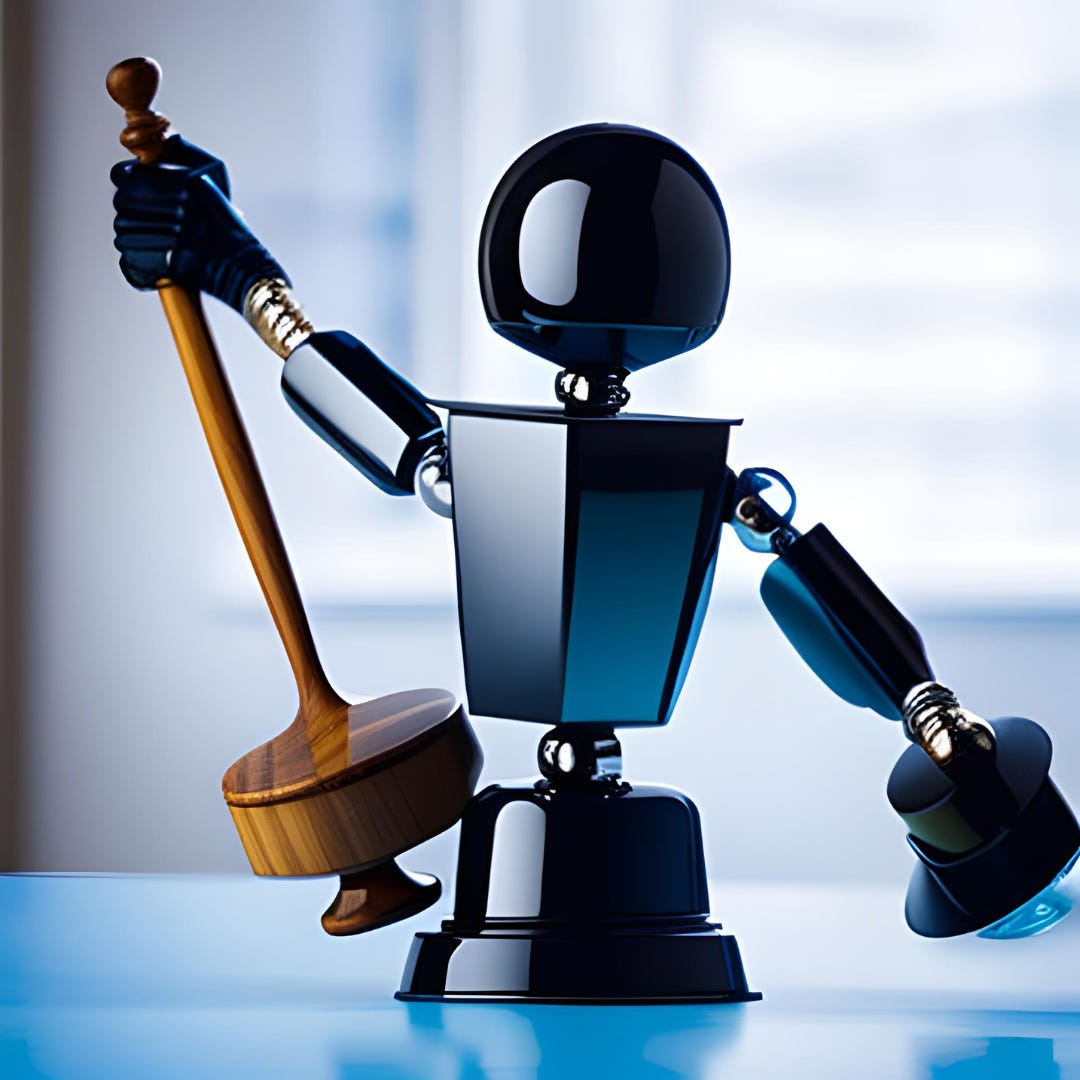
AI (narrow) is already happening. It's not futuristic. “AI is everywhere. It’s not that big, scary thing in the future. AI is here with us.” – Fei-Fei Li
George Orwell's dystopian novel "1984" depicts a totalitarian society where the government, represented by the character of "Big Brother," has complete control over every aspect of citizens' lives, including their thoughts and actions. The novel explores themes such as government surveillance, propaganda, censorship, and the suppression of individual freedom.
The concept of "Big Brother" watching has become a popular reference to describe the idea of government surveillance and the erosion of privacy rights. It has also been used to criticize governments and corporations' increasing use of technology to monitor and track individuals' behavior and activities.
Orwell's novel has had a significant impact on popular culture and has become a touchstone for discussions about government power, individual freedom, and the role of technology in society.
So, what is Narrow AI? Narrow AI, also known as weak AI or applied AI, refers to artificial intelligence systems designed to perform a specific task or a set of functions within a narrow domain.[1] These systems are programmed to operate within specific parameters, and their capabilities are limited to the specific task for which they were designed. Examples of narrow AI systems include voice assistants like Siri or Alexa, facial recognition systems, and chatbots like ChatGPT 3, 3.5, and 4. These systems are designed to perform a specific task, such as answering questions or recognizing faces, and they cannot generalize to other tasks outside of their domain.
In contrast, to narrow AI, general AI, also known as strong AI or artificial general intelligence (AGI), is the hypothetical ability of an AI system to learn and understand any intellectual task that a human can. However, we are yet to develop a general AI matching human-level intelligence.
Narrow AI already shows some characteristics of monitoring and control. For example, about 400 million circuit cameras in China use facial recognition to monitor citizens. That is about 1 for every 3 people. This technology can decipher a person's age, ethnicity, lifestyle, address, family members, and more from gait, voice, facial recognition, spatial/GPS surveillance, and other sensitive data it continuously amasses and connects for each individual. In the UK, every five mins, you're on at least one close circuit camera when moving around. Where not in a highly monitored territory, our cell phones are listening to us and learning who we are, and we have voluntarily ceded these rights to our devices.
That brings us to the legal considerations of Narrow AI, such as:
I. Consent and data privacy: Consent, the right to privacy, and the protection of human rights are fundamental when designing or building AI systems. Therefore, organizations must have the appropriate consent and safeguards to protect personal data when using AI.[2]
II. Bias and discrimination: Narrow AI systems could perpetuate and amplify biases in the data they are trained on. Organizations must ensure that their AI systems are transparent and do not violate anti-discrimination laws, as the right to non-discrimination is fundamental. Organizations may employ the use of explainability tools to avoid unintended harm, promoting trust, understanding, and fairness.[3]
III. IP Issues: AI raises intellectual property issues, such as copyright, trademark, and patent infringement. AI-generated art, music, and videos are becoming more prevalent with the use of text-to-speech, text-to-images, and text-to-video applications. AI could also generate similar patents or even replicate trade secrets. Considering the above, who owns the copyright to these works - as they are created by an AI algorithm rather than a human author? Generally, copyright protection is limited to original works created by human authors. Does this remain the same when AI-generated work involves considerable human creativity or input? Consequently, organizations must have the appropriate licenses and permissions to use any IP in their AI systems.
IV. Liability and responsibility: AI systems will only become more autonomous than they are now. Consequently, questions arise about who takes responsibility when something goes wrong. As a result, organizations must consider accountability and liability issues when deploying AI systems and ensure they have appropriate insurance coverage.
V. Regulation and compliance: Governments worldwide are introducing regulations specific to AI, such as the EU's proposed Artificial Intelligence Act (AIA). As a result, organizations must ensure their AI systems comply with all relevant regulations and standards. Why? Because of all the above-mentioned legal considerations.
The above only mentions a few issues with narrow AI. Other risks/issues include AI security, AI hallucinations, AI misalignment, weaponized AI data – disinformation, vulnerability, commercialization, and more. I generally classify the risks/issues into three categories (grade 1, grade 2, and grade 3) which I will delve into in another article. AGI brings about self-guiding AI like autonomous guiding drones, weapons, cars, or devices. Is this going to get out of control? Will things soon fall apart that the center cannot hold? Who will police these autonomous creations? Who determines what is right and what is wrong? How will AI and humanity co-exist? Should governments control AI?
Narrow AI is fed data and built to do one thing. On the other hand, AGI is building a better and faster system that can do more than human intelligence can achieve (basically, a digital super being). Such AGI would require using several AI systems. There are two likely ways this would be achieved; either by building machines to do this (robotics & machine learning) or by enhancing existing human beings via bioengineering and technology to create cyborgs. A few highly pertinent questions arise. What are these cyborgs going to be? Humans who become cyborgs will be who/what? What rights will robots with AGI have? Where a human being merges with technology, what legal status or rights would accrue to this entity/being? Would human beings with any physically augmenting AI be treated equal to regular human beings? Or would there be super-ability status, just the way we have dis-ability?
Why does all of this concern us? The fact that some scientists take this seriously and that some corporates are creating technologies in this space... makes it a priority. It will soon concern the general populace; consequently, regulatory frameworks must be established to control these dynamics. The global AI regulatory landscape is already being shaped by regulations such as the European Union Artificial Intelligence Act (AIA), Canadian Artificial Intelligence and Data Act (AIDA), United States AI Bill of Rights (AIBoR), US National AI Initiative Act, US Algorithmic Accountability Act of 2022, and more. Is transatlantic consensus with these regulations possible?
We must get people (lawyers, regulators, policymakers, philosophers, ethicists, economists, scholars, technologists, engineers) thinking about this and developing regulatory frameworks immediately. As Elon Musk stated recently unlike other technologies, if we don’t get AI right now, it might be too late to implement once things have gone wrong.
Do you currently have an AI policy and strategy for your firm/organization? Every organization/government/institution needs to have one under their AI roadmap. The time to act is now.
Thanks for reading this article! :) If you enjoyed it, please like, comment, and share the post.
Disclaimer: This article is not intended to provide legal or financial advice. All information, content, and materials available on this site are for general informational purposes only. Areas discussed are also constantly changing with new regulations, laws, cases and so on; Consequently, do ensure you conduct your own personal research before using information herein.
References:
[1] Paschen, U., Pitt, C., & Kietzmann, J. (2020). Artificial intelligence: Building blocks and an innovation typology. Business Horizons, 63(2), 147-155.
[2] Zysman, J., & Nitzberg, M. (2020). Governing AI: understanding the limits, possibility, and risks of AI in an era of intelligent tools and systems. p.2,11-13.
[3] Das, A., & Rad, P. (2020). Opportunities and challenges in explainable artificial intelligence (xai): A survey. arXiv preprint arXiv:2006.11371.